
UNCLE LEONARD
By Connie Arnold
Uncle Leonard came into our lives in the late 1950s when he showed up in our church one Wednesday evening as we began our usual prayer and praise service. A friendly-looking fellow, somewhere in his fifties, he sat quietly by himself up in the ‘amen corner’. The memorable impression that he made with many of us was his blue denim, bibbed overalls. We would learn later that these were his usual, every-day clothes, as he worked for the Chicago, Milwaukee, St. Paul and Pacific Railroad Company. And, we would learn that he was a widowed, bi-vocational pastor at a small, rural church. He visited with us many times after that first service, and he became our uncle about a year later when he married our Aunt Dorval.
Uncle Leonard had worked on the railroad for many years, and he couldn’t remember a winter worse than this one. Heavy snow crunched loudly under his feet. It was January 2: six months more and he planned to retire.
“Well, men, guess we’ll have to brave the cold again,” Leonard shivered as he fastened his jacket closer around his neck, snapped the catch on his lunchbox, and left the shelter where he and his crew had eaten their lunch.
Leonard was track patrolman and usually checked the tracks alone. But, due to the severe weather, his boss sent two other men with him for the inspection on this day. They took a hand car attached to the motor car in case it was needed. They had covered sixteen miles of track when they found a broken rail on a trestle located in a remote, uninhabited area. Leonard sent his men back along the track to locate a new rail, while he set to work on removing the broken section 25 feet above the rocky ground.
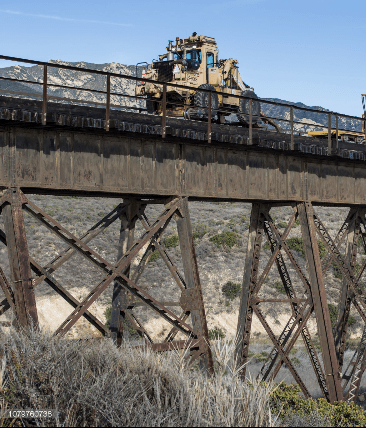
Suddenly his feet slipped on the ice-covered, steel track and he was falling, head first, toward the rocks and snow-rimmed creek below. Instinctively, he put out his hands as his head crashed into the rocks and his feet landed in the water. It was a solid impact.
But he was still conscious. Three weeks earlier, it had become mandatory for railroaders to wear hardhats on the job; now his hardhat had saved his life.
He raised himself slightly, blood dripping from under his hardhat. He couldn’t get up, and the minutes dragged on as he lay helpless. He had looked at his watch shortly before he fell, and it had been 1:30 p.m. When the men finally returned to the trestle, they found him, still conscious, shivering from the pain and the cold.
“Can you walk?” The men knew they should not try to move him but lying out in the cold with his feet in the icy water was not good either.
“I’ll try,” he whispered. With a man on either side, they attempted to support him.
“I can’t.” He sagged between them, and they lowered him gently back onto the ground.
“Build a fire,” one said, “I’ll go call for help.”
The ambulance responded, but could only get within a tenth of a mile from the trestle. The handcar had to bring the stretcher to where Leonard lay. He was put on the stretcher, carried to the handcar, then back to the ambulance, and driven several miles to the nearest hospital.
The doctor’s examination revealed: identical compound fractures on both wrists; nerve damage causing paralysis in both hands; shattered left elbow; cracked pelvis. Even after several hours of lying on the ground, half in the freezing water, there was no sign of damage from exposure. Through it all, he had remained conscious.
To find an orthopedist to repair the broken bones, Leonard was transferred to a larger hospital several miles away. As Divine Providence would have it, an elderly woman was being transported in the ambulance with Leonard. She seemed oblivious to anyone around her even in these close quarters. As the ambulance stopped at the hospital, she seemed to suddenly become aware that she wasn’t alone.
“Lady, do you pray?” It was the first time Leonard had a chance to speak to the woman.
“Ah, no,” she answered, looking at him seriously, “but I should.”
The conversation broke off as the door opened, and Leonard was taken into the hospital and straight to surgery. The doctor would put a pin in Leonard’s left arm from elbow to wrist, in a surgery that took two hours.
Later when his family visited him, he was receiving oxygen, being fed intravenously, and connected to other tubes and wires. He was not a very encouraging sight.
An exchange student from the Philippines was the one who most often wheeled him for the x-rays. Finally, one day he asked quietly, “Are you a man of God?”
Leonard smiled and replied, “Yes, I’m a Christian.”
“When I was a little boy,” the young man continued, “my family was Hindu, but I didn’t have peace. As I grew up, missionaries came telling of Jesus Christ. This was what I’d been waiting for.”
“Well, son, thank the Lord for that!” Leonard’s words of praise brought a look of joy to the orderly’s face.
“Sir, you are like those missionaries. I knew that you were a man of God.”
January 11, stomach surgery was scheduled. The hard fall had caused his stomach to become inactive. Since then, the nurses had listened in vain for it to ‘growl’ as a sign of it becoming ‘alive’. But before he had to go through the ordeal of another surgery, he began to vomit violently, ridding his stomach of the accumulated blood. His body was beginning to heal itself.
January 12, his three sons helped him to take his first walk with no ill effects. He had gone from 230 lbs. down to 160 lbs., including his casts, but he could now start eating. They brought him lettuce: he was delighted
January 21, his doctor released him from the hospital with casts still on his wrists.
February 5, casts were removed from his wrists. The doctor told him it was important to exercise his wrists as much as possible.
February 14, he started regaining feeling in two fingers and the thumbs on both hands.
When Leonard’s arms and shoulders began to ‘freeze’, the doctor prescribed working out with light weights. Instead, Leonard devised an awkward hold on his shovel and rake and worked on the church’s newly-graveled driveway.
February 26, his doctor was so pleased with Leonard’s improvement that he said all danger of amputation was over. Amputation? No one had told him that losing his hands had even been a possibility. Thank you, Lord! His doctor agreed that the Great Physician had intervened.
October 21, surgery to remove the pin from the left arm was performed, and a bone trimmed to make one wrist a little straighter. Leonard could leave the hospital in seven days if all went well. Three days later, the doctor again marveled at his improvement and released him.
November 1, the doctor removed the last cast from his wrist.
January 14, one year and twelve days after his fall, he had his final visit to a doctor.
He had gone through a year of suffering, but he was alive with all of his limbs intact and functional. He was regaining his strength; his muscles returning to normal.
He didn’t question why this happened, as he had always lived by God’s Word that says, “And we know that all things work together for the good of them that love God, to those who are the called according to His purpose”, (Romans 8:28, NKJV).
He had witnessed to the doctor of God’s power in healing intervention; he’d spoken to the lady in the ambulance of her need to pray; and he’d been an example of a Christian to the converted Hindu exchange student.
His recovery would strengthen the faith of all those who had prayed for him. And Eternity will someday clear up any further questions as to why the accident happened.
Uncle Leonard – Railroad man, Sunday School teacher, Pastor, Husband, Christian example, and all-round great guy – passed away May 2, 2005 at age 91.
 Riches of Heaven
I didn’t know all these details about his accident and recovery. I remember we all prayed earnestly for his healing because he was such a great guy. So glad to learn more about the story!
LikeLike